Home is Where the Heart Is

Maria and her cat Joey. January 2026.

Maria first shared her story with ECS in 2024 in “Finding Silver Linings.” Her story made it clear that her resilience and optimism were more powerful than the trauma she experienced. With the help of ECS Uptown Safe Haven (UTSH), Maria was finally able to shed the weight of the struggles that were keeping her down. 

A year and a half later, Maria gave a second interview, this time in the coziness of her own home — the first apartment she’s ever had. “I've never owned anything, and I'm very blessed to have it. I get to be me here. This is my home sweet home, where my heart is.”  

The apartment may be Maria’s private sanctuary, but she happily shares it with someone else: her cat, Joey. Maria adopted Joey from a homeless man outside of a grocery store. When he asked Maria if she had a good home for his kitten, she could proudly respond “yes.” “He's my companion. He makes me happy,” she said. “I know God put him here for me. I know that 100%. I think ‘you didn’t have a home, and I didn't have a home,’ so there you go. We have a home together.”  

Maria expressed that — in many ways — life is new to her now, and she is taking it all in with gratitude, loving every moment. She loves learning new things, enjoys immersing herself in nature walks, and is appreciative of everything she has. 

Giving back is also a passion of Maria’s. She frequently gives money and food to homeless people she sees, and if she can’t give anything away, she makes sure to just be kind and bring a smile to their face. “Making sure that they smile, that makes me happy. That's the happiest times of my day,” she said.  

The most important component of Maria’s life is her spirituality. “To me, being close to God is the most important thing. This is because all of this [is] because of God,” she said, gesturing to her new home. Maria values being close to God and often experiences signs from Him, which she refers to as “synchronicity.” “I find Band-Aids all the time, at least once or twice a week... that's a healing thing,” Maria explained. “I live on God's path. I stay on God's path. And that's why he gives me signs all the time.” 

Maria sits in her new apartment. January 2026.

When Maria still lived at UTSH, a vision board hung on her wall. That vision board is now stored in her closet because everything on it has come true. She brought it out and examined the cut-out images of cats, an iPhone, and words like “healing” and “hope” stuck to the board, all of which she has now. 

She has also progressed from the singular gratitude journal she was writing in every day in 2024 to stacks of dozens of journals; every page filled with lists of the blessings in Maria’s life. “I never missed a date,” she said. “Having gratitude for me goes a long way. I think it makes me very strong, because I got very strong.” 

One thing Maria especially has gratitude for is UTSH. “Safe Haven, that's my second family. I don't know what I would do without them,” she shared. “They got me to where I'm at, and they're my family. I don't have real family here so they're my family. That's my second home here.” 

Maria is grateful for the life she has built around herself and the help UTSH offered to get her to where she is now. As she put it, she is thankful to have a “beautiful home” and a “more beautiful cat.” Maria is set on staying sober from substance use for the rest of her life and living life to the fullest every day. 

Uptown Safe Haven is a residential facility that provides transitional housing and supportive services to chronically homeless single adults with severe mental health issues. To learn more about Uptown Safe Haven, visit https://www.ecscalifornia.org/uptown-safe-haven-1. 

Inside Linda’s Mental Health Recovery at Uptown Safe Haven

When Linda experienced a period of psychosis, her entire life shifted. She was in and out of hospitals and crisis houses, living in complete instability. She lost her source of income as a result, and her car had been destroyed in a flood. She had no choice but to drop out of school and she was asked to leave the choir she sang with as a result of her mental state.

Linda was lost with no clear direction of where to turn next.

That’s when she found ECS Uptown Safe Haven (UTSH).

UTSH gave her a safe and peaceful space where she could find her footing and look toward the future. With the help of staff, group meetings, and her fellow UTSH residents, Linda took control of her life again.

Now, she has a car, an income source, mental peace, and even a dog. She has also been welcomed back to the choir where she regularly sings and writes with an incredible community.

UTSH helped Linda create roots and grow to new heights. To learn more about the transitional housing program, visit Uptown Safe Haven — Episcopal Community Services.

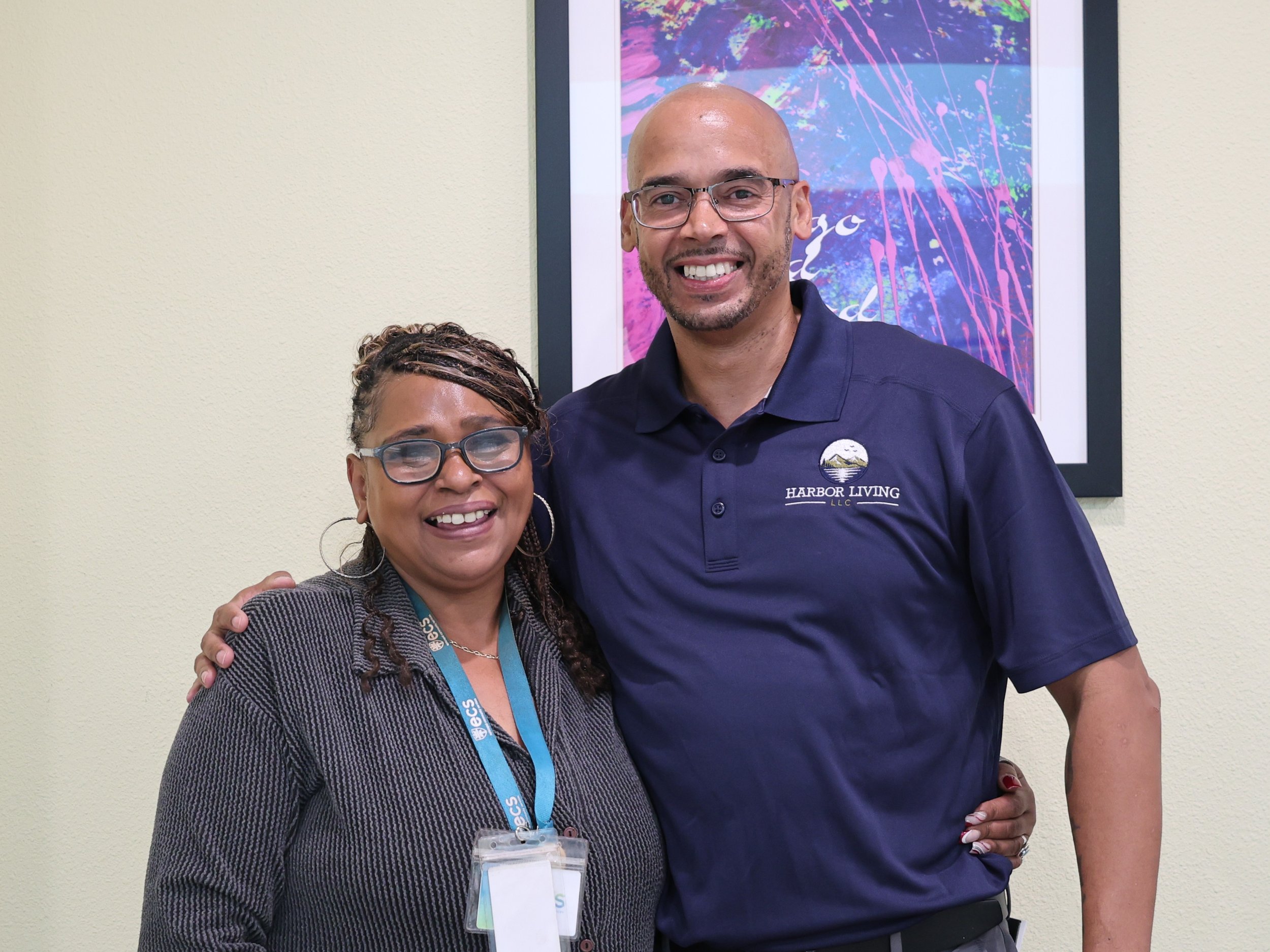
Linda with Development Director Tim Whipple (left) and Resident Assistant Keith Franklin (right). October 2026.

Uptown Safe Haven residents and staff at the annual UTSH Art Show. October 2026.

Coffee & Conversations at PLF

CEO Elizabeth Wilberg (left) and the PLF team smile at Coffee & Conversations. February 2026.

Last Friday, community members gathered at Para Las Familias (PLF) for the annual PLF Coffee & Conversations event. Coffee & Conversations offers an opportunity for people to learn about PLF’s trauma-informed, relationship-based approach, see the therapy rooms firsthand, and connect with other ECS supporters.

Giselle Moreno, Child & Family Therapist, shared the power of PLF with attendees. February 2026.

Attendees enjoyed refreshments and networking before brief speeches from CEO Elizabeth Wilberg and PLF therapist Giselle Moreno. They shared how crucial PLF’s services are, especially for underserved communities. Family therapy sets new generations up for success, breaking down barriers and providing parents with tools that will last a lifetime.

Evelynn, a former PLF parent, attended this year’s event. Evelynn came to PLF for help when her son was diagnosed with autism. “This was my first open door,” she said. “[PLF] taught me where I can go look for help, that I’m not alone, that my child’s not alone, that I’m his voice.” She shared that PLF provided her and her son with tools they still use today.

Guests explore PLF and therapy tools on a guided facility tour. February 2026.

The event closed with group tours of the facility led by PLF staff. Attendees learned about different techniques, practices, and tools the PLF therapists use to help build trust between children and their guardians.

Leslie Manriquez-Jimenez, Associate Director of Children’s Behavioral Health, commented on the significance of Coffee & Conversations. “I think a lot of people want to be supportive of services like ours, want to support their community, want to support children and families. So, coming to events like this actually widens their view of what is out there, what the community needs. It’s really awesome.” ECS extends a huge “thank you” to everyone who showed their support for PLF at Coffee & Conversations.

Coffee & Conversations provided ample opportunity for networking with ECS supporters and staff. February 2026.

Para Las Familias is ECS’ bilingual, bicultural mental health program for young children and their caregivers in San Diego’s South Bay. PLF offers trauma-informed, family-centered care for children ages 0 to 12, many of whom face behavioral health challenges related to trauma, stress, or changes at home or school.

PLF helps strengthen and uplift families, impact that cannot be created without your help. Just $15 can provide a child with a bilingual book and $25 can provide them with a take-home therapy kit. Visit ecscalifornia.org/donate to give to PLF today and ensure brighter futures for San Diego children.

Event guests add what they love to PLF’s tree. February 2026.

CEO Wilberg shares her love for PLF. February 2026.

Dimensions in Art at Uptown Safe Haven

At Uptown Safe Haven (UTSH), this week’s art class centered on the theme of dimensions. Participants experimented with shape, spacing, layering, and color to create depth and movement on their canvases.

In this space of healing and support, art is more than a creative outlet, it’s a powerful tool for rebuilding, reconnecting, and creating lasting change.

Volunteer art teacher assists UTSH resident with art project. February 2026.

Residents express their creativity in art classes. February 2026.